Maximum entropy approximation

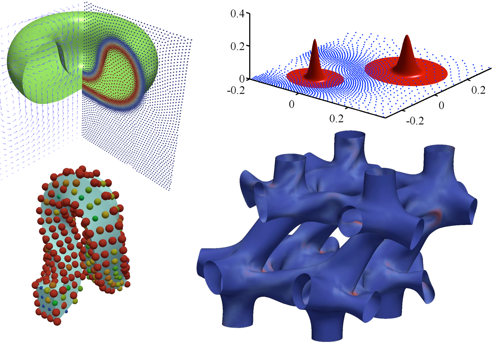
Over the last years, we and other groups (e.g. M Ortiz-Caltech, N Sukumar-UC Davis) have developed approximants selected with the principle of maximum entropy. These meshfree basis functions are defined from a set of nodes alone, are non-negative, very smooth, and are easily constructed in any dimension. They provide very accurate Galerkin approximations to partial differential equations (PDE) with smooth solutions. We have recently used them to parametrize smooth manifolds of dimension up to 6, and to solve 4th order PDE such as those arising in the Kirchhoff-Love theory of shells, or in phase-field models for bio-membranes and fracture.
Publications:
Blending isogeometric analysis and local maximum entropy meshfree approximants
Adrian Rosolen, Marino Arroyo
Computer Methods in Applied Mechanics and Engineering
http://dx.doi.org/10.1016/j.cma.2013.05.015
C. Peco, A. Rosolen and M. Arroyo
Journal of Computational Physics
http://dx.doi.org/10.1016/j.jcp.2013.04.038
A. Rosolen, C. Peco and M. Arroyo
Journal of Computational Physics
http://dx.doi.org/10.1016/j.jcp.2013.04.046
Second order convex maximum entropy approximants with applications to high order PDE
A. Rosolen, D. Millán, M. Arroyo, International Journal for Numerical Methods in Engineering, 94, 150-182 (2013).
Nonlinear manifold learning for meshfree finite deformation thin shell analysis
D. Millán, A. Rosolen, M. Arroyo, International Journal for Numerical Methods in Engineering, 93, 685-713 (2013).
Thin shell analysis from scattered points with maximum-entropy approximants
D. Millán, A. Rosolen, M. Arroyo, International Journal for Numerical Methods in Engineering, 85:723-751 (2011).
A. Rosolen, D. Millán, M. Arroyo, International Journal for Numerical Methods in Engineering, 82:868-895 (2010).
Smooth, second order, non-negative meshfree approximants selected by maximum entropy
C. Cyron, M. Arroyo and M. Ortiz, International Journal for Numerical Methods in Engineering, 79:1605-1632 (2009).
Marino Arroyo and Michael Ortiz, International Journal for Numerical Methods in Engineering, 65:2167-2202 (2006).
Wednesday, September 12, 2012